

Tissue Engineering Market to reach USD 43.71 Billion by 2035 at 11.90% CAGR
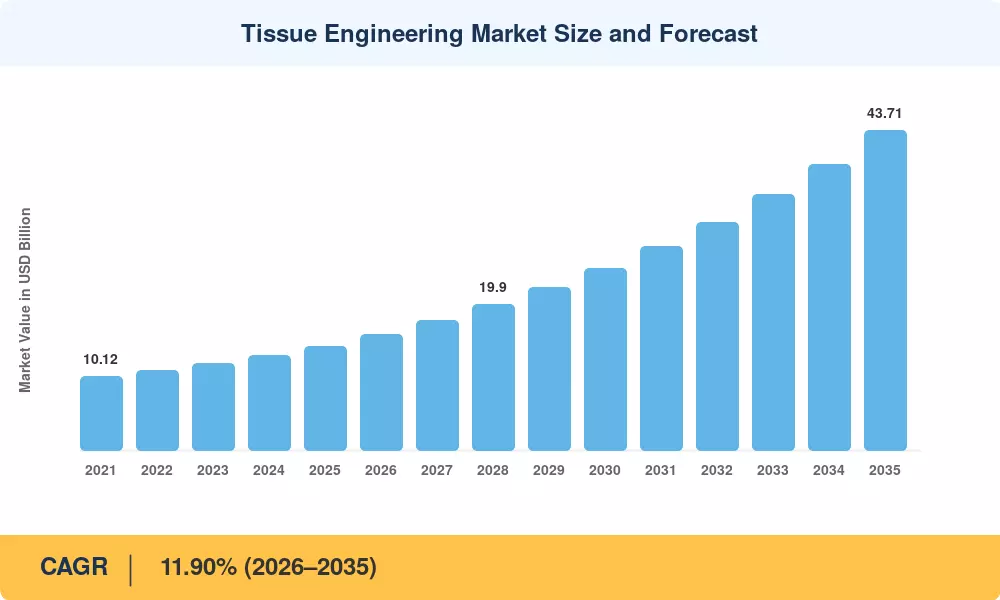
Tissue Engineering Market Size
Tissue Engineering Market to Surge from USD 15.90 Billion in 2026 to USD 43.71 Billion by 2035--By Regulatory Pathway Acceleration, 3D Bioprinting Scale-Up
NY, CA, UNITED STATES, July 16, 2026 /EINPresswire.com/ -- As per Market Research Future, the global Tissue Engineering Market size to reach USD 43.71 Billion by 2035 from USD 15.90 Billion in 2026, at a CAGR of 11.90% during the forecast period 2026--2035. The market base was estimated at USD 14.21 Billion in 2025.The 11.90% CAGR---anchored by structural regenerative medicine demand rather than discretionary healthcare spending---is driven by three converging forces: expanding FDA Regenerative Medicine Advanced Therapy (RMAT) designation pathways that have cut average review timelines by roughly 30% since 2022, sustained 3D bioprinting manufacturing scale-up that has transitioned additive manufacturing platforms from academic prototypes to GMP-ready pilot lines, and trauma and military investment that has pulled battlefield-deployable tissue constructs into civilian pivotal trials for peripheral artery and burn-care applications.
National governments and multilateral health organizations are amplifying this momentum. The U.S. National Institutes of Health allocated over USD 1.8 Billion to tissue-related research in fiscal year 2024 alone. The European Commission's Horizon Europe program committed EUR 420 Million between 2023 and 2027 to advanced biomaterials and scaffold-based tissue repair. Companies operating in the Tissue Engineering Market invested an estimated USD 900 Million in bioprinting infrastructure during 2023--2024. Together, these initiatives are creating the procurement infrastructure and delivery innovation on which the Tissue Engineering Market depends.
Request A Free Sample:
https://www.marketresearchfuture.com/sample_request/2134
Key Market Trends & Growth Drivers
Regulatory Pathway Acceleration
The FDA's RMAT designation, established under the 21st Century Cures Act, has dramatically shortened the path from clinical trial to commercial launch for qualifying tissue-engineered products. By mid-2024, more than 75 products had received RMAT designation, with median review cycles running 40% shorter than standard biologics license applications. Japan's parallel SAKIGAKE framework and the EMA's Priority Medicines (PRIME) scheme are producing similar effects in their jurisdictions, collectively expanding the global addressable market for the Tissue Engineering Market by broadening the set of commercially viable indications within a compressed timeframe. These accelerated pathways mechanically expand the prescription volume for scaffold-based tissue repair, and the regenerative medicine treatment schedule embedded in routine surgical care makes this driver structurally durable through 2035.
Extended survival in chronic disease populations---driven by an aging global demographic where the WHO estimates more than 1.4 Billion people worldwide will be aged 60 or older by 2030---creates a larger prevalent population requiring sustained tissue-engineered interventions. Longer life expectancy transforms osteoarthritis and degenerative disc disease from acute surgical events into chronic conditions with sustained scaffold utilization.
3D Bioprinting Scale-Up
Legacy homogeneous polymer scaffolds, long the default tissue engineering modality, are giving ground to hybrid composites that combine synthetic backbones with bioactive coatings, enabling vascularization and cell integration rates previously limited to autografts. Additive manufacturing platforms capable of depositing cell-laden bioinks layer by layer have transitioned from academic prototypes to GMP-ready pilot lines. Companies operating in the Tissue Engineering Market invested an estimated USD 900 Million in bioprinting infrastructure during 2023--2024, targeting cartilage patches, skin substitutes, and vascular conduits as first commercial targets. Drop-on-demand and extrusion-based systems now achieve resolutions below 100 micrometers, enabling anatomically faithful constructs that outperform conventional mold-cast scaffolds in pre-clinical integration studies.
Pooled procurement through group purchasing organizations drives per-unit prices down for high-volume synthetic polymer scaffolds, expanding access while compressing manufacturer margins. The convergence of computational design with therapeutic bioprinting is creating personalized platforms that tailor tissue-engineered constructs at scale. The U.S. Department of Defense Armed Forces Institute of Regenerative Medicine (AFIRM) has allocated over USD 500 Million since its inception to develop battlefield-deployable tissue constructs for burn care, craniofacial reconstruction, and extremity repair.
Trauma and Military Investment and Chronic Wound Burden
CMS transitional pass-through payment codes and their successor permanent APC classifications tie provider reimbursement to wound-closure and graft-integration outcomes. European data from advanced wound-care registries show that preventing a single amputation saves payers approximately USD 45,000--65,000 per patient. This economic incentive has driven hospital formulary committees to prioritize preventive biologic scaffolds and dermal matrix protocols, shifting procurement budgets toward the Tissue Engineering Market at the expense of reactive surgical intervention spending. Value-based contracts in the United States and European reference pricing for tissue-engineered products have shifted institutional procurement toward early intervention.
The move from inpatient to outpatient administration---as seen with specialty regenerative clinics---decreases facility overhead from full surgical suites to ambulatory procedure rooms per treatment. Ambulatory surgical centers and community wound-care clinics are seeing a rising preference for office-based scaffold applications due to lower operating costs and higher patient throughput.
Ask for Customization:
https://www.marketresearchfuture.com/ask_for_customize/2134
Market Segment Insights
BY MATERIAL TYPE
Synthetic Polymers: Dominant segment with ~57.8% revenue share in 2025. Reflecting entrenched physician familiarity with PLA, PGA, and PCL protocols. Synthetic polymers, available through mature extrusion and electrospinning infrastructure, anchor institutional formularies globally due to their batch-to-batch consistency and competitive unit economics. Hospital procurement teams treat them as default first-line agents, and predictable pricing has enabled broad adoption even in cost-sensitive emerging markets.
Hybrid/Composite Materials: Fastest-growing material segment at 15.0% CAGR (2026--2035). Driven by next-generation performance requirements and expanding clinical indications. Hybrid composites achieving 92% graft integration at 12 months versus 78% for synthetic-only controls in multi-center orthopedic trials could double the segment's addressable population by 2030. The convergence of synthetic structural elements with bioactive coatings is creating personalized platforms that tailor tissue-engineered constructs at scale.
Biologically-Derived Scaffolds: USD 3.98 Billion in 2025. Collagen matrices and decellularized extracellular matrices maintain strong formulary positioning with superior integration outcomes in wound-care and soft-tissue indications. Premium pricing reflects clinical heritage and biocompatibility advantages.
BY APPLICATION
Orthopedics & Musculoskeletal: Dominant application with ~38.6% revenue share in 2025. Approximately 3.5 Million annual knee and hip replacement procedures projected in the U.S. alone by 2030, making scaffold-based tissue repair a near-universal component of orthopedic care pathways. The inherent mechanical load-bearing requirements of joint and spinal applications drive sustained dual-channel demand for synthetic and hybrid scaffolds.
Cardiology & Vascular: Fastest-growing application segment at 14.85% CAGR (2026--2035). Reflecting improved vascular graft technology that extends the window for tissue-engineered interventions. Military-funded vascular graft programs entering civilian pivotal trials for peripheral artery disease create a larger prevalent population requiring sustained tissue-engineered therapy.
Dermatology & Wound Care: USD 2.56 Billion in 2025. Chronic wound prevalence and diabetic ulcer burden anchor this segment. Bioengineered skin substitutes and dermal matrices command premium formulary positioning.
BY END USER
Hospitals & Surgical Centers: Largest segment with ~58.3% share in 2025. Comprehensive surgical service lines and integrated OR workflows dominate volume. Hospitals remain the primary delivery site for complex tissue-engineered implants due to sterile field requirements, specialized bioreactor infrastructure, and GMP compliance licensing.
Specialty Regenerative Clinics: Fastest-growing end-user segment at 14.35% CAGR (2026--2035). Outpatient shift and cost optimization drive demand as office-based scaffold applications reduce the need for full surgical suites. Specialty clinics and community wound-care centers increasingly prescribe ambulatory tissue-engineered options to manage hospital capacity.
Research & Academic Institutes: USD 2.84 Billion in 2025. Grant-funded translational research and the commercial product development pipeline drive demand for scaffold and bioreactor procurement.
Biotechnology Companies: Growing segment at 12.5% CAGR (2026--2035). Cell therapy developers and bioprinting OEMs drive demand for raw biomaterials and manufacturing platforms.
Read Detailed Insights:
https://www.marketresearchfuture.com/reports/tissue-engineering-market-2134
Regional Outlook
North America -- Dominant Market (~48.3% Share, 2025)
The United States generates approximately 82.4% of North American Tissue Engineering Market revenue, driven by the FDA RMAT designation pathway, Medicare reimbursement for advanced wound-care products that exceeded USD 3.5 Billion in 2024, and broad procurement for synthetic polymer scaffold regimens---a single policy ecosystem that converted a research-discipline-dominated market into one with a structural clinical therapy tail. CMS transitional pass-through payment codes under the hospital outpatient prospective payment system have driven adoption in academic medical centers, while community wound-care networks increasingly prescribe office-based tissue-engineered options to manage surgical-suite capacity. The US dominates through a combination of high per-patient spending, robust payer coverage, and rapid bioprinting adoption.
Canada contributes through CIHR regenerative medicine grants at 10.8% of regional share, while Mexico is growing at steady pace on medical tourism and private hospital expansion at 6.8% of regional share. North America's leadership rests on reimbursement depth and the structural regenerative medicine segment created by expanded RMAT compliance mandates and value-based care contracts.
Europe -- Second Largest (~26.0% Share, 2025)
Europe's Tissue Engineering Market reflects divergent national strategies---Germany leads regionally with a strong medtech manufacturing base and high orthopedic procedure volumes, contributing the largest single-country share, while the UK historically used selective scaffold targeting before broadening coverage through NHS innovation accelerator programs for advanced wound-care and cartilage repair products. France contributes ~14.2% of regional share through its national strategy for regenerative medicine that has directed EUR 200 Million toward clinical translation infrastructure since 2022. Italy contributes ~11.8% on orthopedic procedure volume. Spain is growing on public hospital modernization at 7.5% of regional share.
Harmonization pressure from the EU Medical Device Regulation is gradually narrowing these differences, lifting baseline demand across the region. The European Commission's Horizon Europe program mandates equitable access to regenerative medicine products, including tissue-engineered implants across all member states. The Nordic countries hold ~8.3% of regional share on digital health integration. Russia contributes ~4.2% on domestic manufacturing incentives. Centralized health technology assessment bodies---NICE, G-BA, and HAS---have progressively widened reimbursement for tissue-engineered products across surgical indications.
Asia-Pacific -- Fastest-Growing Region (14.95% CAGR, 2026--2035)
Asia-Pacific is the engine of the Tissue Engineering Market. China holds the largest regional share with ~34.5% of regional revenue, driven by NMPA pathway reform for regenerative medicine products and extensive hospital construction pipelines---instantly extending tissue-engineered product access across a billion-plus population. India is growing at 15.60% CAGR on the back of the National Biopharma Mission and rising orthopedic demand. Japan contributes USD 0.52 Billion through SAKIGAKE designation and an aging population where over 29% of citizens are 65 or older. South Korea holds ~12.8% of regional share on biotech R&D investment.
ASEAN economies hold significant regional share on healthcare infrastructure build-out at 13.90% CAGR. The rest of Asia-Pacific is growing on varied adoption stages. The region's combined contribution anchors the global volume base for tissue-engineered product demand. Asia-Pacific represents the highest-growth opportunity, driven by a confluence of aging demographics, urbanization, and government investment in regenerative medicine infrastructure.
Middle East & Africa -- Emerging Opportunity (~3.5% Share, 2025)
The Middle East & Africa is bifurcated between well-funded Gulf states and resource-constrained Sub-Saharan nations. Saudi Arabia leads the region with Vision 2030 healthcare investment, contributing ~28.0% of regional share---over USD 65 Billion earmarked for hospital and research infrastructure development has created pockets of excellence for tissue-engineered treatments. The UAE is growing at 12.85% CAGR on medical tourism and specialty clinics. South Africa contributes ~18.5% on academic research infrastructure.
Egypt is growing at 14.0% CAGR on public hospital modernization. NGO-supported regenerative medicine access programs underpin demand across the rest of the region. Manufacturing cost barriers in LMICs remain a restraint---real-world evidence indicates that GMP production of a single autologous cartilage patch costs between USD 15,000 and USD 40,000 before hospital markup. These costs lead to treatment discontinuation and physician reluctance to initiate early preventive regimens, indirectly narrowing the Tissue Engineering Market addressable population.
Competitive Landscape and Recent Developments
The Tissue Engineering Market displays low concentration, with the top five companies holding an estimated 28--34% combined revenue share. The Herfindahl-Hirschman Index sits below 800, reflecting a fragmented competitive environment where specialized innovators coexist with diversified medtech conglomerates. Barriers to entry are moderate---regulatory expertise and clinical evidence requirements are high, but capital-efficient bioprinting and contract manufacturing models have lowered the threshold for new entrants.
The competitive landscape is stratified between premium wound-care scaffold pioneers serving global tissue engineering markets, bioprinting platform expansion specialists capturing regenerative medicine tenders, and orthopedic biologics developers consolidating the bone graft substitute segment.
KEY COMPANIES AND RECENT MILESTONES
Integra LifeSciences (2024--2025): Maintains leadership with dermal regeneration templates and collagen matrices, commanding ~6--9% of global Tissue Engineering Market revenue. Premium wound-care and neurosurgery scaffold positioning in specialty segments offsets price compression in competitive markets.
Organogenesis Holdings (2024--2025): Market leader in advanced wound management with bioengineered skin substitutes and wound-care biologics, holding ~5--8% of global revenue. Broad commercial footprint in outpatient wound-care channels anchors a strong global franchise.
Smith & Nephew (2024--2025): Orthobiologics and negative-pressure wound therapy reinforce the broad orthopedic and wound-care portfolio positioning, holding ~4--7% of global revenue. The company benefits from the structural regenerative medicine tail created by expanded sports-medicine procedure volumes.
Medtronic (2024--2025): Spinal fusion biologics and collagen-based implants reinforce the leveraging global distribution network for tissue-engineered products positioning, holding ~3--6% of global revenue.
Stryker (2024--2025): Bone graft substitutes and 3D-printed implants reinforce the additive manufacturing integration positioning, holding ~3--5% of global revenue.
Zimmer Biomet (2024--2025): Cartilage repair systems and bone void fillers reinforce the orthopedic specialization positioning, holding ~3--5% of global revenue.
Future Outlook: 2026--2035
By 2030, precision bioprinting theranostics will become the operating system of tissue engineering management. The convergence of patient-specific imaging and additive manufacturing will reshape the Tissue Engineering Market through the late 2020s. By 2030, an estimated 40% of newly diagnosed chronic wound patients in academic medical centers will undergo AI-optimized scaffold design followed by matched bioprinted tissue repair, creating a diagnostic-therapeutic revenue loop.
The NIH's USD 1.8 Billion annual tissue-related research funding ensures domestic innovation scales alongside clinical demand. Machine-learning models that integrate genomic, proteomic, and imaging biomarkers can recommend optimal scaffold selection and surgical sequencing for individual patients. Start-ups have raised over USD 800 million in venture funding for regenerative medicine decision-support tools since 2023.
More Related Research Insights:
https://www.marketresearchfuture.com/reports/oncology-market-27935
https://www.marketresearchfuture.com/reports/regenerative-medicine-market
https://www.marketresearchfuture.com/reports/3d-bioprinting-market
https://www.marketresearchfuture.com/reports/wound-care-market
https://www.marketresearchfuture.com/reports/orthopedic-biologics-market
https://www.marketresearchfuture.com/reports/cell-therapy-market
https://www.marketresearchfuture.com/reports/advanced-wound-care-market
https://www.marketresearchfuture.com/reports/medical-devices-market
Larry Wilson
WantStats Research And Media Pvt. Ltd.
+1 855-661-4441
email us here
Visit us on social media:
LinkedIn
Facebook
YouTube
X
Legal Disclaimer:
EIN Presswire provides this news content "as is" without warranty of any kind. We do not accept any responsibility or liability for the accuracy, content, images, videos, licenses, completeness, legality, or reliability of the information contained in this article. If you have any complaints or copyright issues related to this article, kindly contact the author above.
